
[email protected]WhatsApp: +8618857971991
ISO 13485-Oriented Medical Tube RFQ Support
LogoMedical Hypotubes
Get a Quote
LogoMedical Hypotubes
WhatsApp
ISO 13485 & 9001-Oriented QMS
Burr-Free Electropolished Finish
CTQ Microscopic Inspection
Prototype to Mass Production
LogoMedical Hypotubes

ISO 13485-oriented sourcing support for medical hypotubes, nitinol tubing, catheter marker bands, and laser-cut micro tube components.

Inquiry Email

[email protected]

Email app

Best for drawings, tolerance tables, inspection needs, and quote history.

Instant Chat

+8618857971991

Chat on WhatsApp

Fast path for OD/ID, material, sample quantity, and lead-time questions.

ISO 13485:2016-Oriented QMS
ISO 9001:2015-Oriented QMS
Products
  • Medical Hypotube
  • Laser Cut Hypotube
  • Nitinol Tubing
  • Catheter Marker Bands
  • Endoscope Snake Bone Tube
  • Stainless Steel Tubing
Capabilities
  • 5-Axis Laser Cutting
  • Electropolishing & Passivation
  • Nitinol Shape Setting
  • PFAS-Free Medical Tube
  • Micro Tube Inspection
  • Rapid Prototyping
  • ISO 13485 Manufacturing
Applications
  • Balloon Catheter
  • Stent Delivery
  • Neurovascular
  • Endoscope Bending
Resources
  • RFQ Checklist
  • Engineering Blog
  • About Us
  • Contact / RFQ
  • Privacy Policy
  • Terms of Service
  • Cookie Policy
© 2026 Medical Hypotubes. All Rights Reserved.|Operated by Magatom Dynamics Co., Ltd.
Learn/0.012" OD Hypotubes

0.012" OD Hypotube: Specifications & Calculator

Explore the critical dimensions of 0.012 inch (0.3048 mm) outer diameter hypotubes, widely used in advanced neurovascular and cardiovascular device delivery systems.

Calculate ID and lumen areaRequest drawing review

Interactive sizing tool

0.012" OD Hypotube Dimension Calculator

Select a wall profile or enter a custom wall thickness to estimate inner diameter, lumen area, and a relative stiffness proxy before opening an RFQ.

Reviewed July 20, 2026

Wall profile

Formula used: ID = OD - 2WT. The tool keeps the nominal OD fixed at 0.0120" (0.3048 mm).

Treat the output as an early feasibility screen. Final drawings still need tolerance, ovality, coating build, and lot-specific inspection review.

Calculation ready

Balances lumen area, shaft support, and manufacturability for many delivery shafts.

Inner diameter

0.0080"

0.2032 mm

Wall thickness

0.0020"

0.0508 mm

Lumen area

0.03243

mm2 (5.027e-5 in2)

Stiffness proxy

8.168e-10

in4, relative tube-wall comparison only

Result interpretation

This profile gives a nominal 0.0080" ID. Compare it with the guidewire, mandrel, coating, and fluid-path requirements before locking the drawing.

Request 0.012" quote or sample

Micro-Scale Precision & ASTM A908

ASTM A908/A908M is a procurement reference for austenitic stainless steel needle tubing, but it does not replace a device-specific drawing. Treat 304V or 304LVM strength, temper, and lot traceability as supplier-certified requirements verified by mill test reports.
Wall Thickness Trade-offs

A thin wall (0.002") increases flow area but sacrifices pushability. Regular wall (0.003") provides better structural integrity for guidewire components.

Advanced Laser Cutting

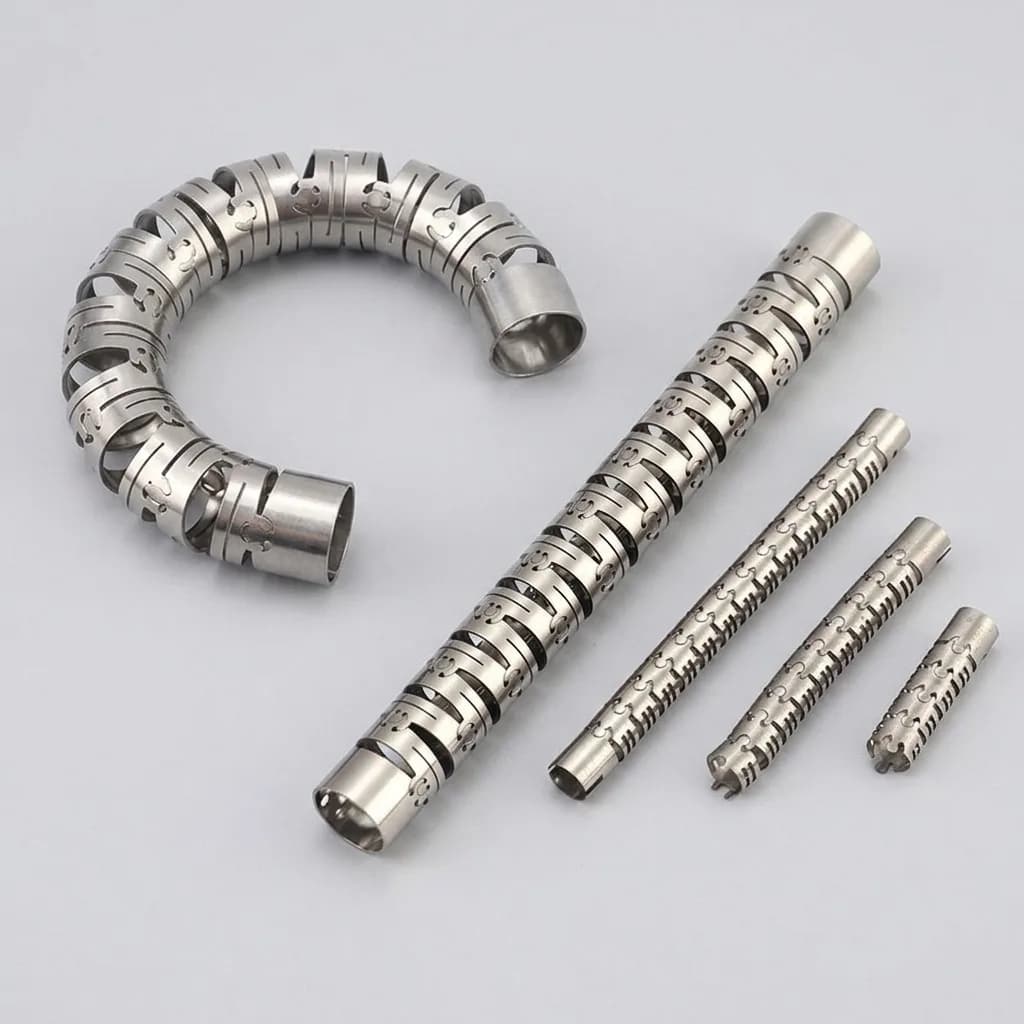
Because of their small OD, these tubes require ultra-fast laser processing and post-process inspection to create spiral, skived, or intermittent cuts without burrs, excessive heat effects, or loss of dimensional control.

Cross-Sectional Visualization

0.012 inch OD hypotube cross sectionDiagram showing outer diameter, inner diameter, and wall thickness for a 0.012 inch OD hypotube.OD: 0.012" (0.3048mm)IDWT

Diagram illustrating the relationship between Outer Diameter (OD), Inner Diameter (ID), and Wall Thickness (WT).

laser-cut stainless steel hypotube samples for 0.012 OD design review

Sample Evidence Before Release

At 0.012" OD, a nominal catalog dimension is only a starting point. Ask the supplier to connect each sample lot to measurable evidence before the design is released or a laser-cut pattern is frozen.

  • Measured OD, ID or wall, ovality, and concentricity on the actual lot.
  • Microscopy or inspection photos showing cut-edge burr, recast, and coating build where applicable.
  • MTR, certificate of conformance, first-article inspection, and passivation or surface-treatment records.

Standard Specifications for 0.012" OD Hypotubes

Profile NameWall (in)ID (in)ID (mm)Primary Use Case
Regular Wall0.0030"0.0060"0.1524High pushability micro-catheters
Thin Wall0.0020"0.0080"0.2032Neurovascular delivery shafts
Extra Thin Wall0.0015"0.0090"0.2286Maximum internal lumen capacity

These are nominal screening examples for early design work. Final procurement drawings should define OD, ID or wall, concentricity, straightness, surface finish, coating build, and the inspection method used for each critical-to-quality dimension.

Decision Method: From Dimension to RFQ

Use the calculator for a first-pass geometry check, then confirm the assumptions below before asking for samples or quoting a production drawing. The most common mistake is optimizing only for lumen area while ignoring tolerance stack, coating build, and post-processing yield.

Decision InputHow to Check ItDesign Implication
Inner diameterID = OD - 2WT, then subtract coating and worst-case tolerance stack.Governs guidewire clearance, mandrel fit, and fluid path capacity.
Lumen areaCompare calculated area against the device's minimum flow or payload requirement.A small ID change can create a large area change at this scale.
Wall strengthUse tube moment of inertia as a comparison proxy, then validate with bend, kink, and compression tests.Thinner walls improve lumen size but reduce process margin and handling robustness.
Supplier evidenceRequest MTR/COC, first-article inspection, and coating or passivation records with the sample lot.Public standards narrow the baseline; lot records prove the part actually shipped.

Design Risks (Kink & Column Strength)

When specifying an extra thin wall (e.g., 0.0015") for a 0.012" hypotube, the component becomes highly susceptible to kinking and buckling under compressive loads. This risk is particularly high in tortuous vascular pathways.

Mitigation: Implement varying pitch spiral laser cuts or integrate PTFE coatings to reduce friction and improve trackability without thinning the wall.

Manufacturing Tolerances

Due to the small dimensions, standard industry OD tolerances typically sit at +0.0005" / -0" (or ±0.0005"). However, for precision medical applications such as neurovascular delivery, ultra-tight tolerances of ±0.0002" (±0.005 mm) may be required for consistent device assembly and concentricity.

Recommendation: Only request ultra-tight tolerances on critical-to-quality (CTQ) dimensions to avoid unnecessary cost inflation.

Evidence Limits

A published standard or catalog dimension is not enough to release a medical component. Confirm the actual heat, temper, finish, inspection method, and process route for the supplier lot being evaluated.

Recommendation: Ask for a short feasibility review when the drawing combines 0.012" OD, extra-thin wall, coating, laser cuts, or very tight concentricity.

Data Sources & Evidence

Published July 20, 2026; reviewed July 20, 2026. Use this page as a pre-RFQ screening guide, not as a substitute for a released device drawing, supplier-specific certificate, or controlled copy of a purchased standard.

  • -
    ASTM A908/A908M needle tubing: ASTM's public scope describes austenitic stainless steel needle tubing in hard-drawn temper, including small ODs from 0.008" to 0.203" and nominal walls from 0.002" to 0.015". Confirm the revision and purchased text before placing requirements on a drawing. ASTM A908/A908M-24 source
  • -
    ASTM F899 material context: ASTM's public scope describes chemistry requirements for wrought stainless steels used for surgical instruments. It is a useful material-family reference, but it does not by itself prove implant suitability, tubing temper, or supplier lot performance. ASTM F899-23 source
  • -
    Supplier MTR/COC: The RFQ should ask for mill test reports, certificate of conformance, heat number, melt route, temper, surface treatment, and first-article measurements for the actual 0.012" OD sample lot.
  • -
    Inspection evidence: Use measured OD, ID or wall, concentricity, ovality, straightness, burr condition, and coating thickness to decide whether a nominal profile can move from sample evaluation to a controlled design input.

Frequently Asked Questions

Can 0.012" hypotubes be PTFE coated?

Yes. PTFE coating adds approximately 0.0002" to 0.0005" to the outer diameter. It is crucial to specify if the 0.012" requirement is for the bare metal OD or the final coated OD.

What is the most common material for these tubes?

304V or 304LVM stainless steel is common when the design needs stainless hypotube behavior and supplier documentation. Nitinol may be better when the shaft needs superelastic recovery rather than stainless column support.

Are laser-cut patterns possible at this diameter?

Yes. Advanced femtosecond laser cutting can create precise spiral, skewed, or intermittent patterns on 0.012" OD tubes to tune the flexibility profile along the catheter shaft. The quoted process should include burr, recast, and dimensional inspection evidence.

Is 0.012" OD the same as a gauge size?

Do not substitute gauge callouts for drawing dimensions. Gauge charts can help with early sourcing language, but the controlled requirement should state OD, ID or wall, tolerances, and finish.

What wall thickness should I start with?

Start with 0.002" thin wall when both lumen and support matter, then compare against 0.003" regular wall and 0.0015" extra-thin wall using the calculator. Move to samples before freezing the design.

Which tolerances should be called out on the RFQ?

Call out only the dimensions that control device performance: usually OD, ID or wall, concentricity, length, straightness, and coating thickness. Over-tightening non-critical dimensions can raise cost without improving the device.

What should be included in a 0.012" OD hypotube RFQ?

Include the intended material, OD, ID or wall, tolerances, length, finish, coating, laser-cut pattern if any, inspection plan, target quantity, and whether samples need MTR/COC documentation.

When is 0.012" OD not a good starting point?

Reconsider the OD when the device needs a larger guidewire clearance, heavy coating build, aggressive laser cut density, or high compression load in tortuous anatomy. A slightly larger OD can improve manufacturing margin.

Related Engineering Resources

  • View all Medical Hypotube Products & Capabilities
  • Compare Laser-Cut Hypotube Pattern Options
  • Prepare a Drawing-Based Hypotube RFQ Checklist
  • Explore Neurovascular & Cardiovascular Applications
  • Learn about 12XX Extra Thin Wall Hypotubes
  • Explore 15TW (15 Gauge Thin Wall) Hypotubes
  • Review 16XXTW high-clearance hypotube constraints
  • Compare 19G Thinwall & Flow Efficiency

Inquiry Email

[email protected]

Email app

Best for drawings, tolerance tables, inspection needs, and quote history.

Instant Chat

+8618857971991

Chat on WhatsApp

Fast path for OD/ID, material, sample quantity, and lead-time questions.