
303 Hypotube: Material & Sizing Review
303 is a free-machining stainless steel with reduced formability and weldability compared with 304. For a drawn or laser-slotted shaft, request a supplier review of 304L/316L candidates; dry machined fittings need a separate review. An alloy name alone cannot qualify a patient-contact component.
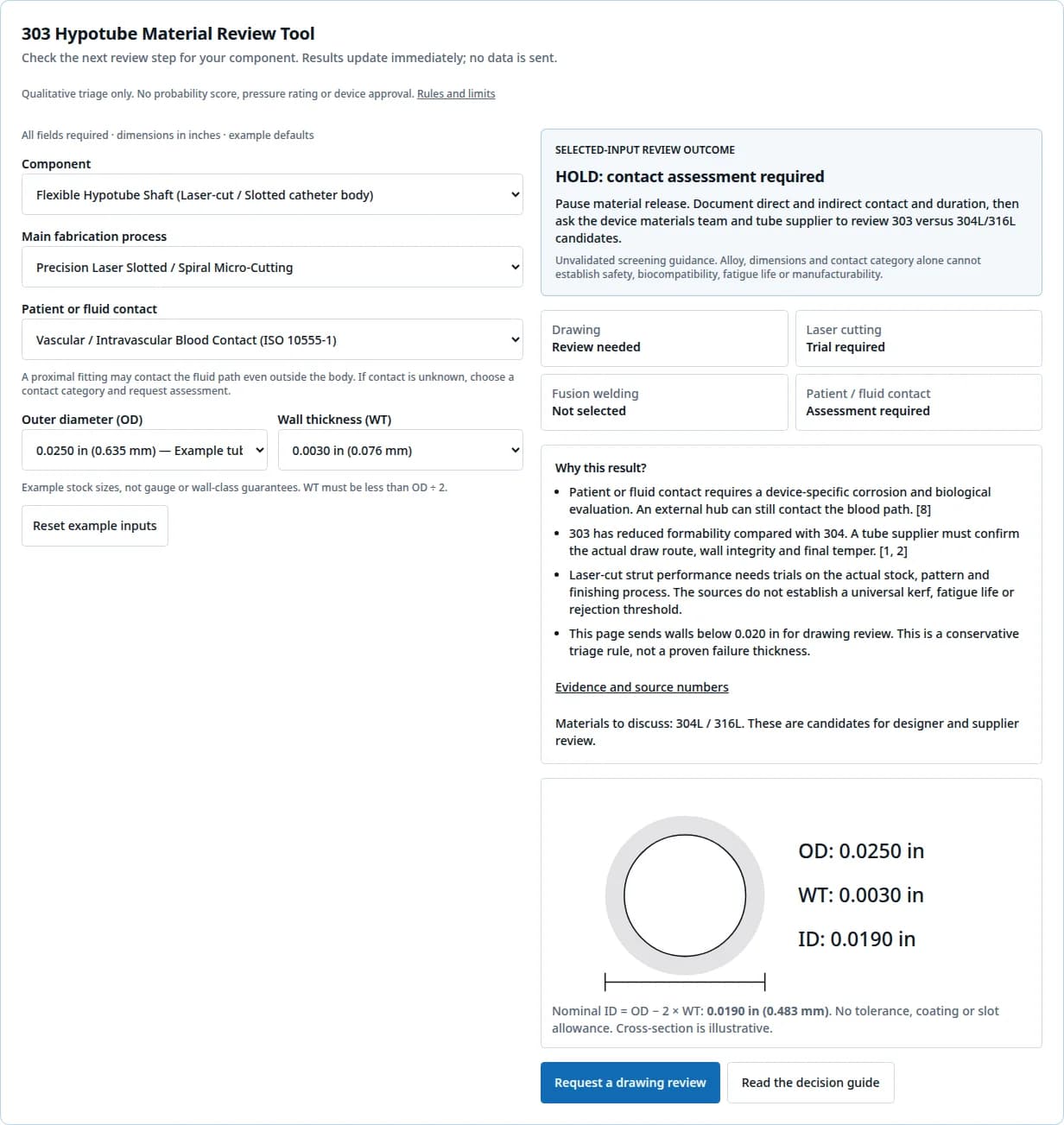
Start with the material review tool ↓303 Hypotube Material Review Tool
Check the next review step for your component. Results update immediately; no data is sent.
Qualitative triage only. No probability score, pressure rating or device approval. Rules and limits
Selected-input review outcome
HOLD: contact assessment required
Pause material release. Document direct and indirect contact and duration, then ask the device materials team and tube supplier to review 303 versus 304L/316L candidates.
Unvalidated screening guidance. Alloy, dimensions and contact category alone cannot establish safety, biocompatibility, fatigue life or manufacturability.
Drawing
Review needed
Laser cutting
Trial required
Fusion welding
Not selected
Patient / fluid contact
Assessment required
Why this result?
- Patient or fluid contact requires a device-specific corrosion and biological evaluation. An external hub can still contact the blood path. [8]
- 303 has reduced formability compared with 304. A tube supplier must confirm the actual draw route, wall integrity and final temper. [1, 2]
- Laser-cut strut performance needs trials on the actual stock, pattern and finishing process. The sources do not establish a universal kerf, fatigue life or rejection threshold.
- This page sends walls below 0.020 in for drawing review. This is a conservative triage rule, not a proven failure thickness.
Materials to discuss: 304L / 316L. These are candidates for designer and supplier review.
Technical decision guide · Published · Reviewed · Medical Hypotubes editorial team. Public source scopes and supplier guidance; no unpublished production data are claimed.
1. Decide by component, process and contact
The useful question is whether the specified stock and process can meet this component’s requirements. A machinable fitting and a flexible shaft need different evidence. Treat 304L/316L as comparison candidates for a shaft drawing review, and treat dry machined 303 hardware as a separate decision.
Decision summary — engineering review recommendationsScroll horizontally on small screens; keyboard users can focus the table and use arrow keys.
| Situation | Recommended next step | Evidence boundary |
|---|---|---|
| Drawn shaft | Compare 304L/316L stock and temper; request draw-route evidence. | 303 formability guidance is available; lot-specific draw yield is unknown. [1, 2] |
| Laser-slotted shaft | Review stock, pattern, finishing and cyclic testing together. | No cited 303 process window or universal fatigue threshold. |
| Dry Swiss-machined fitting | Consider a 303 machining review. | Requires confirmed isolation from patient and fluid paths. [1, 8] |
| Any patient or fluid contact | Hold material release for contact assessment. | No alloy name alone establishes biological suitability. [8] |
2. What free-machining 303 changes
Supplier data describe sulfur-assisted chip breaking as 303’s machining advantage, with reduced formability, weldability and corrosion resistance relative to 304. Those tradeoffs justify a process review; they do not establish a universal minimum wall thickness. Atlas also lists cold-drawn bar, so “303 cannot be cold drawn” is too broad.
Known material facts versus information still neededScroll horizontally on small screens; keyboard users can focus the table and use arrow keys.
| Item | Public information | Confirm for the drawing |
|---|---|---|
| Designation | 303 / S30300 / approximate EN counterpart 1.4305. [1] | Contractual designation, product form and heat certificate. |
| Sulfur | Atlas bar sheet lists S ≥ 0.15%; Sandmeyer sheet lists 0.15–0.35%. [1, 2] | These are product/specification contexts, not one universal limit. |
| Strength | Bar data depend on size and condition. [1, 2] | Actual tube proof strength, tensile strength, elongation and temper. |
| Inclusions | Supplier guidance identifies sulfide-related corrosion concerns. [1] | Lot-specific cleanliness, orientation and post-process integrity. |
3. Laser cuts require process evidence
A slotted shaft needs more than an intact tube before cutting. The review should connect kerf geometry, remaining strut width, surface condition and flex duty. The public sources used here do not quantify 303 laser-cut yield, recast thickness or fatigue life. Elemental sulfur’s boiling point cannot by itself predict ablation of sulfides within a steel matrix.
Ask for a representative coupon plan: stock lot and temper, slot geometry, laser settings, deburring or electropolishing sequence, inspection method and cyclic-load acceptance criteria. Define which evidence belongs to the tube supplier and which belongs to the device manufacturer.
4. Qualify the complete joint
Sandmeyer does not recommend 303 for applications requiring welding. If a drawing combines a 303 hub with a welded shaft, request a joint review before ordering. Switching to a mechanical or adhesive joint also requires validation for the actual loads, fluids and cleaning process.
Joining review checklist — no universal acceptance loadsScroll horizontally on small screens; keyboard users can focus the table and use arrow keys.
| Route | Review question | Required evidence |
|---|---|---|
| Fusion welding | Are alloy pair, temper and thermal cycle suitable? | Qualified procedure, cross-section inspection and assembly performance. |
| Crimp / press fit | Can tolerance and wall variation change retention? | Worst-case tolerance samples, retention and leak testing as applicable. |
| Adhesive bonding | Are cure, fluids and residues controlled? | Cure validation, aging, bond testing and relevant biological evaluation. |
5. Separate corrosion from biological evaluation
Supplier corrosion guidance identifies sulfide inclusions as pitting initiation sites in 303. It does not provide a clinical time-to-failure prediction. PREN is a composition screening index; it cannot establish the response of a finished component, surface treatment or patient-contact configuration.
Document direct contact, indirect fluid-path contact and duration. A luer fitting outside the body may still be part of the communicating fluid path. FDA’s framework uses these distinctions to guide biological evaluation; the tool therefore routes all declared contact categories to assessment.
6. Compare candidates without automatic substitution
Drawing-review candidates and tradeoffsScroll horizontally on small screens; keyboard users can focus the table and use arrow keys.
| Candidate | Reason to discuss it | Open decision |
|---|---|---|
| 303 | Machining-oriented dry hardware candidate. [1, 2] | Exposure, joining, formability and actual stock evidence. |
| 304 / 304L | Discuss when forming or welding drives the specification. [1] | Exact grade, supplied temper and finished tube requirements. |
| 316 / 316L | Discuss when chloride pitting resistance drives selection. [1] | Confirm grade and condition; no blanket implant approval. |
| Other alloys | A device-specific motion or strength target may require another route. | Specialist material and process review; no automatic recommendation here. |
A stronger supplied temper may change forming and joining behavior. Compare finished components in specified conditions; comparing annealed 303 with heavily cold-worked 304L would confound grade and processing. Ask the designer to approve any material change.
7. Use dimensions with tolerances
The tool’s nominal ID calculation is reproducible: ID = OD − 2WT, and 1 in = 25.4 mm. For the default 0.025 in OD and 0.003 in wall, ID is 0.019 in (0.4826 mm). This arithmetic does not include coating, ovality or manufacturing allowances.
Worked geometry example — illustrative, not supplier capabilityScroll horizontally on small screens; keyboard users can focus the table and use arrow keys.
| Input or output | Nominal | Illustrative limits / interpretation |
|---|---|---|
| Outer diameter | 0.0250 in | Assume ±0.0005 in only for this example. |
| Wall thickness | 0.0030 in | Assume ±0.0003 in only for this example. |
| Inner diameter | 0.0190 in | Independent worst case: 0.0179–0.0201 in. |
| Fit, strength and pressure | Not determined | Require actual tolerances, finished geometry, material data and tests. |
No burst or fatigue number is calculated. Slots, welds, bends and surface defects can govern failure, and the tool has no validated model for them.
8. Match the standard to its scope
Standards context checked 2026-11-10 — public scopes onlyScroll horizontally on small screens; keyboard users can focus the table and use arrow keys.
| Reference | Relevant scope | Limit on interpretation |
|---|---|---|
| ASTM F899-23 [3] | Surgical-instrument steel chemistry. | Not a blanket 303 blood-contact ban or a device certificate. |
| ASTM F138-19 [4] | S31673 implant bar and wire. | Not generic S31603 tube; confirm product-form requirements. |
| ASTM A632-19(2025) [5] | Small-diameter general-service austenitic tubing. | Check scope and condition; default 0.025 × 0.003 in is below the published OD/WT range. |
| ISO 9626:2016 [6] | Rigid stainless steel needle tubing. | Flexible tubing is outside its scope. |
| ISO 10555-1:2023 [7] | General requirements for sterile single-use intravascular catheters. | Select applicable requirements from the full standard and device assessment. |
These links establish scope, not conformance. Confirm the applicable edition at design release and obtain the full standard where needed. An alloy certificate, a tube inspection record and a finished-device verification report answer different questions.
9. Three worked review scenarios
These are hypothetical examples of using the tool, not customer cases or measured production outcomes.
Laser-cut blood-contact shaft
Inputs: 0.025 in OD × 0.003 in WT; flexible shaft, laser cutting, blood contact.
Result and next step: HOLD. Nominal ID is 0.019 in. Obtain contact assessment and compare stock candidates, cut trials and finished-shaft tests before material release.
Dry Swiss-machined hub
Inputs: 0.125 in OD × 0.030 in WT; machined hub, Swiss turning, no patient or fluid contact.
Result and next step: CANDIDATE. Nominal ID is 0.065 in. Confirm isolation, loads, finish and machining feasibility; this is not permission to manufacture.
Tissue-contact bushing
Inputs: 0.125 in OD × 0.030 in WT; distal bushing, Swiss turning, percutaneous contact.
Result and next step: HOLD. A thick machined component still requires contact assessment. The external-hardware candidate rule does not apply.
10. Tool rules, uncertainty and procurement risks
The tool applies editorial workflow rules, not a calibrated statistical model. Any selected patient/fluid contact returns HOLD. Dry external Swiss-machined hubs or handle hardware with wall ≥ 0.020 in return CANDIDATE. Every other valid combination returns REVIEW. The 0.020 in cutoff is a conservative triage convention with no demonstrated material acceptance threshold.
OD is limited to 0.005–0.500 in and WT to 0.001–0.100 in for this interface; these limits are not manufacturing capability claims. WT must be less than OD ÷ 2. Empty, malformed, out-of-range and solid-section inputs suppress the result and offer correction, reset and drawing-review paths. All calculations are local and immediate.
Known unknowns and minimum mitigationScroll horizontally on small screens; keyboard users can focus the table and use arrow keys.
| Risk | What remains unknown | Minimum next action |
|---|---|---|
| Misuse | Actual corrosion, biological response, pressure and service life. | Obtain device-specific evidence; do not release material from this tool. |
| Cost | Stock availability, minimum order, trial scrap, inspection and finishing effort. | Request an itemized quote and pilot-lot plan rather than assuming savings from machinability. |
| Scenario mismatch | Contact paths, joint loads, final temper or slot pattern omitted from input. | Supply the full drawing and process sequence to the reviewer. |
No verified shop yield, kerf distribution, joint force, fatigue curve, price or lead time is available for the selected combination. Those values remain unknown until appropriate supplier or device evidence is obtained.
11. Sources and evidence boundaries
Sources checked 2026-11-10. Supplier sheets support qualitative material comparisons; public standards scopes support scope statements only. Tool triage rules, trial suggestions and worked scenarios are editorial engineering guidance. They are explicitly separate from measured data and device qualification.
- [1] Atlas Steels: 303 bar data sheet
Supplier data, revised April 2006. Bar chemistry, machining, formability, weldability and corrosion comparisons; not a hypotube trial.
- [2] Sandmeyer Steel: Alloy 303 specification sheet
Supplier data, PDF revision link December 2022. Machining and forming guidance; product-specific chemistry and mechanical values cannot be transferred to arbitrary tubing.
- [3] ASTM F899-23: surgical-instrument steels
Public scope: chemistry for wrought surgical-instrument steels. Does not establish blanket blood-contact bans or certify a device.
- [4] ASTM F138-19: implant bar and wire
Public scope: UNS S31673 bar and wire. Neither a generic S31603 substitution nor a finished-tube specification.
- [5] ASTM A632-19(2025): small-diameter tubing
Public scope: general-service austenitic tubing. Confirm dimensional range and supplied condition before invoking it on a drawing.
- [6] ISO 9626:2016: rigid needle tubing
Public scope excludes flexible tubing. Edition status should be checked at design release; a revision is in development.
- [7] ISO 10555-1:2023: intravascular catheters
Public scope: sterile single-use intravascular catheters. The applicable full standard and device risk assessment govern performance requirements.
- [8] FDA: biological evaluation by device contact category
Contact nature and duration guide the evaluation. Includes indirect blood paths; alloy names alone do not determine biological suitability.
12. Questions before a drawing review
Material and process
Can 303 be supplied as a medical hypotube?
Do not assume an alloy name establishes stock availability or qualification. Ask a tube supplier for the exact form, dimensions and process history. Reduced formability makes 303 a review item for drawn shafts; the cited sources do not prove that every 303 tube is impossible. [1, 2]
Is 303 the same as 304L?
No. 303 is a free-machining grade; 304L is a different composition and procurement designation. A substitution needs designer approval and confirmation of tube temper, tolerances and joining requirements. [1]
Does the tool predict laser kerf quality?
No. It identifies the need for trials. Laser parameters, tube stock, cut geometry and finishing must be evaluated together; no universal kerf width or fatigue-cycle guarantee is supplied.
Is welding 303 absolutely forbidden?
Sandmeyer does not recommend it for applications requiring welding. An unusual joining route needs its own procedure qualification and acceptance criteria; a warning about weldability is not a universal legal prohibition. [2]
Can electropolishing make 303 equivalent to 316L?
A finishing process does not change the bulk grade. Verify surface condition, corrosion and cleaning results on finished parts rather than treating polishing or passivation as an alloy substitution.
Contact and standards
Does ASTM F899 ban all 303 patient contact?
That conclusion is not supported by the cited public scope. F899 concerns surgical-instrument steel chemistry. Patient-contact suitability requires a separate device-specific assessment. [3, 8]
Does ASTM F138 certify a 316L hypotube?
No. Its published scope is UNS S31673 implant bar and wire. Verify the required material designation and product form instead of relabeling generic 316L tube as F138 certified. [4]
Can an external luer fitting still require biological evaluation?
Yes. A fitting can be outside the body while contacting a fluid path that communicates with the patient. Assess direct and indirect contact and duration before selecting a material. [8]
Does ISO 9626 cover flexible laser-slotted shafts?
Its published scope is rigid stainless steel needle tubing and explicitly excludes flexible tubing. Dimensional guidance does not establish complete flexible-shaft compliance. [6]
Sizing and procurement
What does the calculated inner diameter mean?
ID = OD minus twice wall thickness, in the same units. It is a nominal geometric value and excludes tolerances, ovality, coatings, burrs and laser-cut features. It cannot confirm guidewire clearance or pressure capability.
Why does the result say HOLD for tissue contact?
This page uses HOLD to require contact assessment before material release. It is a conservative workflow instruction, not a claim that a particular device fails a biological test. [8]
Is a 0.020 in wall a proven 303 acceptance limit?
No. The tool uses it only to route thicker, dry, Swiss-machined hardware into a candidate review. Walls below it require process review; neither side of the boundary establishes safety.
Can this tool calculate burst pressure or service life?
No. Pressure, fatigue and joint strength need material-condition data, actual geometry and validated tests. A nominal ID calculation is not a pressure or lifetime rating.
What should accompany a drawing-review request?
Include OD, ID, wall and tolerances; length; alloy and temper; cut pattern; joining sequence; direct or indirect contact and duration; loads; surface requirements; quantity; and the required inspection evidence.
Are lead time and scrap percentages known?
No verified lot-specific data are available here. Request a supplier quote, pilot-lot yield and an inspection plan. Catalog stock and a new custom draw can have different constraints.
Turn the result into a drawing-review request
Include OD/ID/wall with tolerances, length, alloy and temper, cut pattern, joining route, patient/fluid contact and duration, loads, finish, quantity and inspection needs. If some requirements are unknown, identify them in your inquiry so the review can start with the missing decisions.