
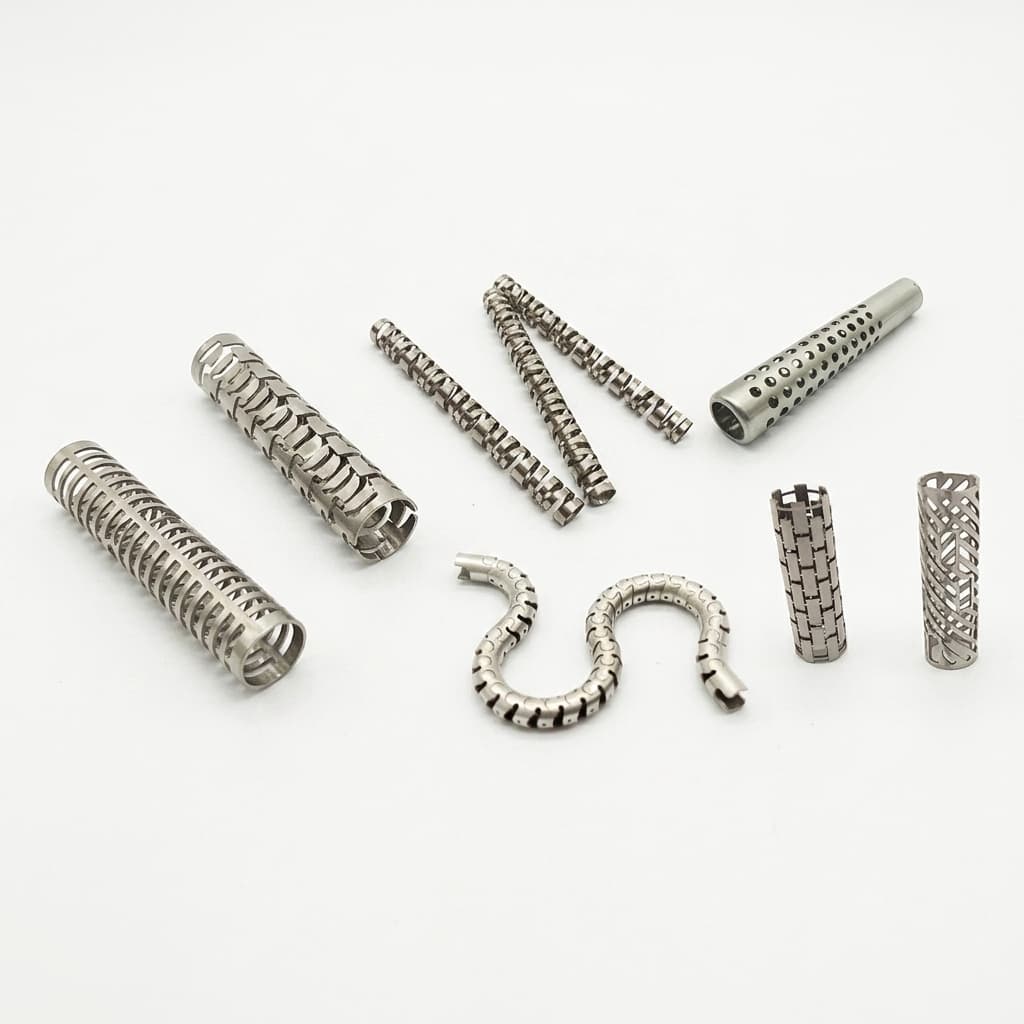
How to Specify Laser Cut Hypotube Patterns for Flexible Medical Devices
A technical engineering guide on designing and specifying laser-cut patterns for hypotubes, including spiral, interlocking, and hinge cuts, with precise RFQ dimensioning tips.
The transition from a rigid metal hypotube to a highly flexible, trackable catheter shaft is made possible by precision 5-axis laser cutting. By removing material in specific geometries, engineers can precisely tune the flexibility, torquability, and pushability of a medical tube without transitioning to braided polymers.
However, translating a functional need into a manufacturable CAD drawing and RFQ can be challenging. In this guide, we explore the most common laser cut patterns, structural limitations, and exactly what buyers need to specify to ensure successful, scalable manufacturing.
What is a Laser Cut Hypotube?
A laser cut hypotube is a rigid, thin-walled medical tube (usually made of 304V stainless steel or Nitinol) that has been micro-machined with a laser to create precise geometric slots or spirals along its length. This process transforms the rigid metal tube into a highly flexible component that can navigate tortuous human anatomy while retaining excellent column strength (pushability) and rotational control (torquability). They are the core structural backbone for interventional catheters, stent delivery systems, and steerable endoscopes.
1. Common Laser Cut Patterns Evaluated
A. Continuous Spiral (Helical) Cut
This is the simplest and most common cut. A single, continuous helical slit is laser-machined down the length of the tube.
- Pros: Excellent, highly uniform flexibility. Very cost-effective and fast to machine.
- Cons: Extremely poor torque transmission. When rotated in the direction of the cut, the tube will "unwind" or expand (spring effect), leading to poor control and potential vessel damage.
- Best For: Simple delivery systems where pushability is needed but torque response is completely irrelevant.
B. Interrupted Spiral (Interlocking / Puzzle) Cut
Instead of a continuous cut, the laser creates a series of interlocking puzzle-piece-like cuts along a helical path.
- Pros: Maintains excellent flexibility while significantly improving torque response (approaching 1:1). The interlocking "dovetail" features physically prevent the tube from "unwinding" under rotational stress.
- Cons: Higher machining time and slightly higher cost due to the highly complex, multi-axis toolpath.
- Best For: Steerable neurovascular catheters and advanced delivery systems where flexibility and torque response both need careful tuning.
C. Hinge (Slot) Cut
Discrete slots are cut perpendicular to the tube axis, leaving "hinges" (un-cut bridges) between the slots. The placement of these hinges dictates the bending plane.
- Pros: Can be designed for uni-directional, bi-directional, or omni-directional bending. Offers precise mechanical control over the bending radius and high column strength.
- Cons: More prone to kinking or fracture if the slot width and un-cut bridge dimensions are not matched to the tube's wall thickness and fatigue targets.
- Best For: Steerable endoscope bending sections, deflectable catheter tips, and articulating surgical instruments.
2. Key Dimensions to Specify in Your RFQ
When you send a drawing to a supplier like Medical Hypotubes, missing specifications lead to delayed quotes and engineering friction. Your CAD drawing must explicitly define the following four parameters:
Figure 1: Cross-sectional schematic of a slotted hinge pattern.
| Design Parameter | Engineering Definition | Typical Manufacturing Limits |
|---|---|---|
| Pitch (P) | The longitudinal distance between consecutive cuts or spirals. | Tighter pitch = higher flexibility. Can be as fine as 0.010" depending on wall thickness. |
| Slot Width / Kerf (W) | The actual width of the removed material. | Limited by the laser spot size. Typical ranges are 0.0005" to 0.0015" (12µm - 38µm). |
| Un-cut Bridge Width (B) | The solid material left intact between cuts. Critical for preventing structural fracture. | Golden Rule: Bridge width should generally be ≥ 1.2x the tube's wall thickness to ensure fatigue resistance. |
| Cut Angle / Bevel | The angle of the laser beam relative to the tube surface. | Standard is 90° (perpendicular), but off-axis cuts can be specified for unique articulating joints. |
3. Transition Zones: Managing the Stiffness Gradient
A well-designed catheter does not jump abruptly from rigid to flexible; it utilizes a Transition Zone. By gradually altering the pitch of the laser cut over a specified length (e.g., transitioning from a 0.100" pitch down to a 0.020" pitch over 50mm), engineers can create a smooth stiffness gradient.
Buyer Tip: Explicitly dimension the start and end points of the transition zone on your drawing, and state whether the pitch change is linear or non-linear.
4. The Hidden Cost: Post-Processing
Laser cutting generates intense localized heat, which inevitably creates slag, dross, and heat-affected zones (HAZ). Specifying the post-processing is just as important as the cut pattern itself.
- Deburring / Ultrasonic Cleaning: Removes sharp edges and loose particulate that could damage inner liners (like PTFE) or outer jackets (like Pebax).
- Electropolishing: Removes microscopic burrs and the brittle HAZ, rounding the cut edges. This significantly improves the flexural fatigue life of the flexible section and prevents jacket tearing. (Read our full engineering guide on Electropolishing Medical Hypotubes).
5. Copy-Paste RFQ Template
To ensure you get an accurate quote the first time, copy and paste this block into your RFQ email to your supplier:
SUBJECT: RFQ - Laser Cut Hypotube - [Your Project Name]

Material: [e.g., 304V Stainless Steel]
Tubing OD: [e.g., 0.040" +/- 0.0005"]
Tubing ID: [e.g., 0.030" +/- 0.0005"]
Cut Pattern: [e.g., Interrupted Spiral / Hinge Slot]
Kerf (Slot Width) Limit: [e.g., 0.001" Max]
Minimum Un-cut Bridge Width: [e.g., 0.012"]
Post-Processing: [e.g., Ultrasonic Clean + Electropolish to Ra < 0.2µm, Burr-Free at 40x]
Expected EAU (Annual Quantity): [e.g., 10,000 pcs]
At Medical Hypotubes, laser-cutting and finishing routes are reviewed around your tube geometry, material, tolerance stack, and edge-condition requirements. Electropolishing can be specified to reduce burr, recast, and fatigue-initiation risk before downstream assembly. Send us your solid model and drawing today for a manufacturability review.
Author

Categories
More Posts
Nitinol vs. Stainless Steel in Catheter Design: Material Selection Guide
A technical evaluation on choosing between nitinol tubing and stainless steel hypotubes for your next catheter or endoscope project.
Radiopaque Marker Bands: Platinum-Iridium vs. Gold for Catheter Visibility
A technical comparison of Pt-Ir, Gold, and Tantalum marker bands, with critical RFQ tolerancing guides for catheter assembly.
Medical Hypotube Miniaturization: Navigating Ultra-Thin Walls for Neurovascular Catheters
Medical hypotube miniaturization guide for ultra-thin neurovascular catheter walls. Compare tolerances, materials, failure modes, and RFQ trade-offs.